Importance of Play in Early Years
In a world increasingly focused on early achievement and academic readiness, one of the most powerful tools for learning in early childhood remains beautifully simple: play.
For young children, play is not merely recreation or “free time.” It is how they investigate ideas, make sense of experiences, build relationships, develop language, strengthen neural connections, and construct understanding about the world around them.
At Kai, we believe play is not separate from learning, it is the foundation of meaningful learning.
Contemporary early childhood research consistently highlights the importance of play in early childhood because children learn best through active, hands-on, and socially meaningful experiences. Through play, children develop not only cognitive and academic foundations, but also the emotional resilience, creativity, confidence, and problem-solving skills that support lifelong learning.
Why Play Is Your Child’s Most Important Work
The early years are a period of extraordinary brain development. During this stage, children are constantly building neural pathways through movement, exploration, communication, sensory experiences, and social interaction.
Play provides the ideal environment for this development to occur naturally and meaningfully.
Whether children are building with loose parts, engaging in imaginative role play, exploring natural materials outdoors, or collaborating with peers during open-ended activities, they are actively developing essential developmental competencies.
Research in early childhood education emphasises that play-based experiences support the development of:
- Executive functioning skills such as attention, working memory, and cognitive flexibility
- Language acquisition and communication skills
- Social-emotional competence and self-regulation
- Creativity, inquiry, and critical thinking
- Gross and fine motor coordination
- Independence, resilience, and confidence
Most importantly, play nurtures intrinsic motivation, the natural desire children have to explore, discover, and learn.
When learning feels joyful and meaningful, children engage more deeply, retain understanding more effectively, and develop positive dispositions toward learning itself.
Why is play important for preschool children?
Young children are naturally active, curious learners. They are not designed to learn primarily through passive instruction or prolonged periods of sitting still. Instead, they learn by doing, exploring, questioning, experimenting, and interacting with their environment.
This is why play is especially important during the preschool years.
Through play, children develop the foundational skills that underpin future academic learning and emotional well-being.
Play supports social and emotional development
Collaborative play experiences help children learn how to negotiate, communicate, cooperate, and navigate social relationships. As they engage with peers, children begin developing empathy, perspective-taking, and emotional awareness.
Pretend play and storytelling also provide valuable opportunities for children to process emotions, express ideas, and make sense of real-life experiences in developmentally appropriate ways.
These experiences strengthen emotional resilience and support the development of self-regulation — a skill strongly linked to long-term success in both school and life.
Play strengthens cognitive development
When children build structures, create imaginary worlds, solve puzzles, or experiment with materials, they are engaging in higher-order thinking processes.
They learn to:
- Plan and predict
- Investigate cause and effect
- Solve problems creatively
- Adapt ideas flexibly
- Persist through challenges
Open-ended play experiences also support inquiry-based learning by encouraging children to ask questions, test theories, and construct understanding independently.
Play supports physical development
Movement is deeply connected to learning in early childhood.
Climbing, balancing, running, painting, threading, pouring, and manipulating small objects all contribute to the development of gross and fine motor skills. These experiences strengthen coordination, body awareness, concentration, and control — all essential for future classroom learning.
Sensory-rich and movement-based experiences also support cognitive processing and emotional regulation, particularly during the early years when children learn most effectively through embodied experiences.
What does play-based learning in preschool look like?
One of the most common misconceptions about play-based learning preschool environments is that play lacks structure or intentionality.
In reality, high-quality play-based learning is deeply purposeful and thoughtfully designed.
At Kai, educators carefully create environments and experiences that provoke curiosity, encourage exploration, and support holistic development across all domains of learning.
For example:
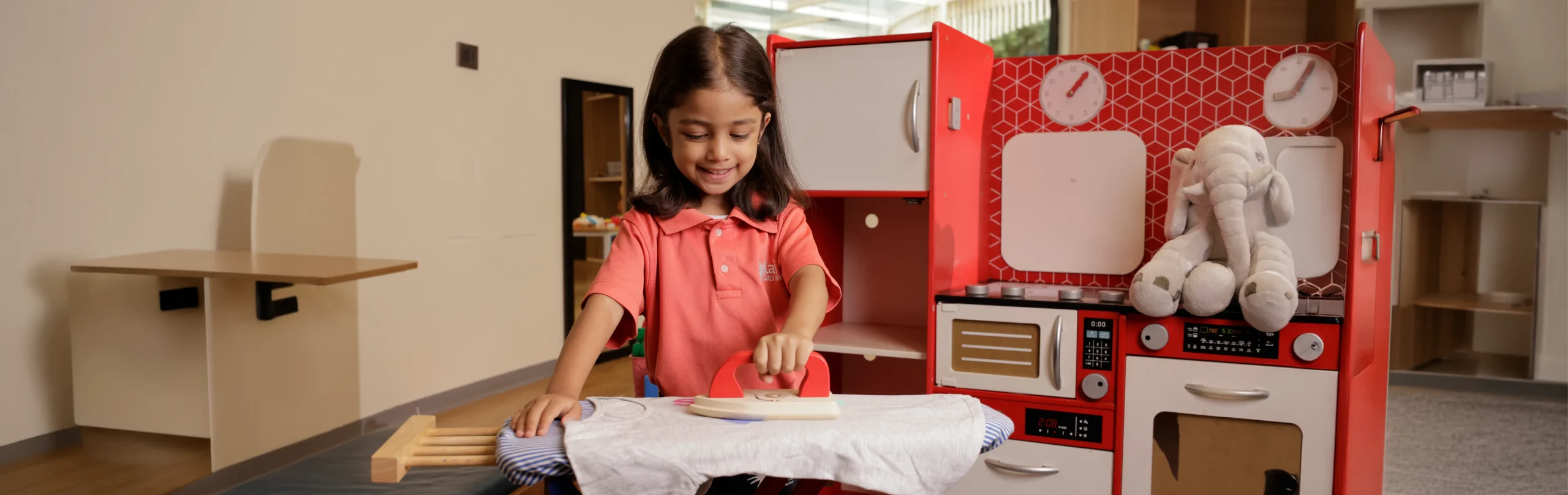
- A dramatic play area may strengthen literacy, communication, social negotiation, and symbolic thinking.
- Block play may support early mathematical concepts, spatial reasoning, collaboration, and engineering thinking.
- Water and sensory exploration may introduce scientific inquiry, prediction, measurement, and problem-solving.
- Storytelling and loose-parts play may encourage creativity, language development, and imaginative thinking.
In these environments, educators act as facilitators of learning, observing, questioning, extending thinking, and guiding children toward deeper understanding through meaningful interactions.
This approach reflects constructivist learning theory, which recognises that children build knowledge most effectively through active engagement and authentic experiences.
The benefits of play for child development
The benefits of play for child development extend far beyond the preschool years.
Research increasingly shows that children who engage in rich play experiences develop stronger foundations for:
- Communication and literacy
- Numeracy and problem-solving
- Emotional intelligence
- Collaboration and relationship-building
- Creativity and innovation
- Adaptability and resilience
Play also supports the development of executive functioning skills, the mental processes that enable children to focus attention, regulate emotions, remember instructions, and manage tasks effectively.
These skills are now widely recognised as some of the strongest predictors of long-term academic and life success.
Importantly, play allows children to develop these competencies in ways that feel meaningful rather than pressured.
How does play-based learning prepare children for school?
In conversations around school readiness, there is often a tendency to focus narrowly on academic milestones. However, research consistently demonstrates that children thrive in school when they possess strong social-emotional, cognitive, and self-regulation skills alongside early literacy and numeracy foundations.
This is precisely how play-based learning prepares children for school.
Through meaningful play experiences, children learn to:
- Communicate ideas confidently
- Work collaboratively with others
- Sustain attention and manage impulses
- Think critically and solve problems
- Approach challenges with resilience
- Develop curiosity and motivation for learning
Rather than memorising information in isolation, children build deep conceptual understanding through active exploration and real-world connections.
Most importantly, they begin to see themselves as capable, competent learners.
Reclaiming the value of childhood
At Kai, we believe childhood should not be rushed.
The early years are not simply preparation for the next stage of schooling; they are a profoundly important stage of life in themselves.
When children are given opportunities to play, inquire, create, move, collaborate, and explore, they are building far more than academic skills. They are developing identity, confidence, empathy, resilience, creativity, and a lifelong relationship with learning.
In a world that often prioritises outcomes and acceleration, play reminds us that meaningful learning is not always measured by how quickly children achieve, but by how deeply they engage, connect, and grow. Because for young children, play is not “just play.” It is some of the most important work they will ever do.